
Your child is another year older and just a little bigger. Is it time to move up to the next car seat option? I’ve just purchased a 123 group car seat and it’s safe to say, I love it! Car seat safety is a hot topic and it seems every day I see statistics about parents not using the correct seat or not using the seat correctly. Whether your child wants out or you think it would just be more convenient, it’s important for parents to know when to stop using a booster seat. If you have a big kid that is still little in size, this might help.

Before you read further, I want to point out that I am not a car seat or booster seat professional. I have done a lot of research, but have also found that there is a lot of conflicting information out there. Always use your own best judgment and consult the experts with questions.
The U.S. Department of Transportation’s National Highway Traffic Safety Administration (NHTSA) has lots of helpful information to help you choose the right seat for your child at SaferCar.gov.
Why my middle schooler uses a booster seat
Most of the parents I know let their child stop riding in a booster seat around age 8 or so. Both of my kids – age 9 and 11 as of this post – still use one. Although nobody has ever said anything, I can imagine that at least a few parents think I’m being overly cautious.
My daughter starts sixth grade this year and on the first day of middle school, she will ride in a booster seat, as she has for years.
She doesn’t find it embarrassing, or at least doesn’t say so.
She’s also very small for her age {as is my son too}. To me, that’s the important part. For babies and toddlers, car seat guidelines are usually based on height and weight more than age. She is under the height and weight guidelines, so she stays in a booster seat.
Safety will always trump being cool.
Booster seat guidelines
You would think that it should be easy to just look up the laws for child safety seats, right? Here’s the catch: each state sets its own laws or guidelines and they’re not too specific. Most say that a child has to be in some type of restraining system until a certain age. In the state of Texas, where I live, children under age 7 or 4-foot-9-inches have to be in a safety seat.
It doesn’t matter which one your child reaches first. Technically, since my kids are older than 7, they don’t legally have to ride in boosters anymore.
If you have kids, you’ve probably noticed that in an average first-grade class {or any age group, really} there can be a big difference in height. Neither of my kids are 4-foot-9 yet, but some of their friends are as tall as I am.
As far as national guidelines go, the American Academy of Pediatrics recommends a child ride in a booster seat until they hit the magical height of 4-foot-nine-inches and the adult seat belt “fits correctly.” They add that this can be anywhere between age 8 and 12.

My booster seats
Texas does not have a weight recommendation for booster seats, though many other states says under 80 pounds. There is a blanket statement that says to follow the booster seat’s user manual.
My kids have different booster seats, bought at different times. My daughter’s booster seat says it can be used up to 4-foot-9 and 100 pounds. My son’s seat can be used up to 4-foot-9 and 110 pounds.
The booster seats aren’t the only important thing when it comes to safety. This is probably what makes finding guidelines so confusing.
The headrest should be protecting the back of any passenger’s head. The seatbelt should fall across the thighs {NOT across the stomach} and cross the center of the shoulder and chest. (American Academy of Pediatrics, above)
These guidelines are important no matter what your child is sitting on. The purpose of a booster is to position the child so that the seat belt hits the right locations. This is true for adults too. Depending on the vehicle, I have to adjust my seat so that the seat belt hits me in the right places. There are probably vehicles that I can’t drive.
I’m 5-foot-5, so height isn’t the issue here. For both kids and adults, it’s important to check how the seat belt fits. If it doesn’t cross the middle of your chest, it isn’t going to hold you in a sudden change.
Booster seat height chart
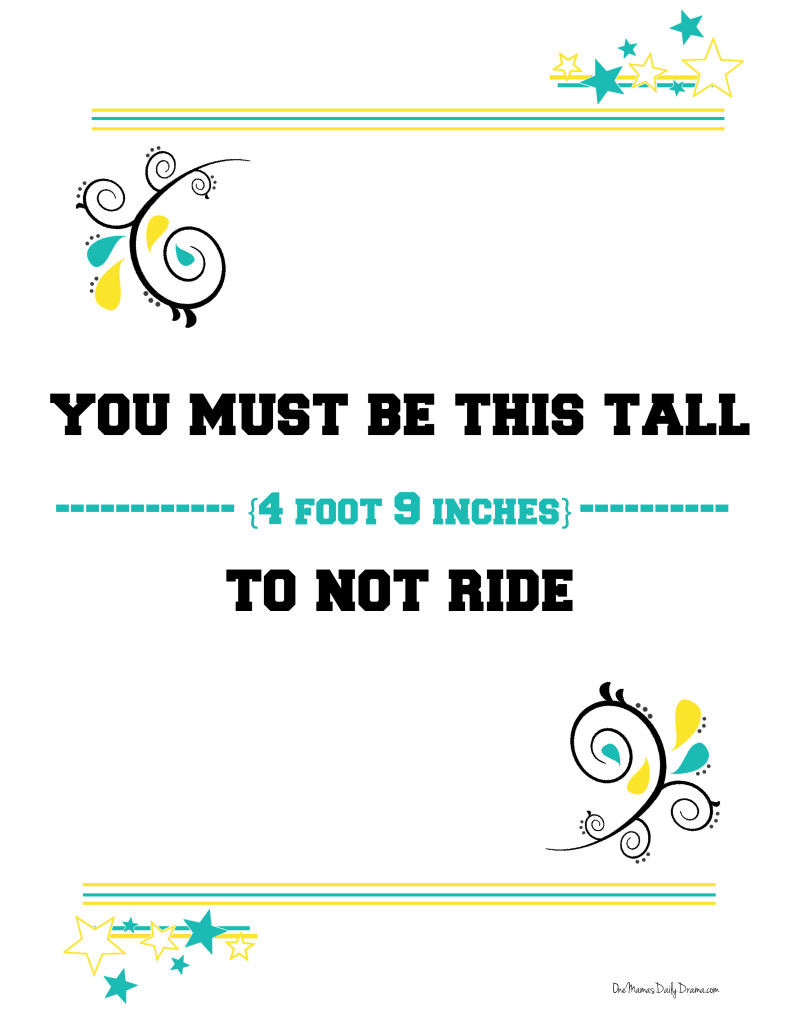
Like most terribly boring things that I make my kids do, I try to make riding in a booster seat a little more fun. To do that, I created a height chart to hang on the wall.
It’s kind of the reverse of those height charts you see at amusement parks. If you want your own copy, you can download and print one HERE.
I hung mine on the wall, using a tape measure to be precise. Now the kids can check their height as often as they like. They can see how they’re growing and getting closer to ditching the booster seats.
So what’s a parent to do? I think in this case, being overly cautious is not bad.
What do you think?
It hit me as I was reading this that baby seats, high chairs, and all other baby accessories now seem to come with expiration dates for the plastic in them. Is this the same for booster seats? I know many folks buy them at garage sales and wonder if they should be looking for that date too?
Thanks for the reminder! I hadn’t checked mine in a while. Yes, booster seats expire too. I would never buy a car seat/booster at a garage sale anyway. When getting something like this secondhand, it’s important to know its history. If a car seat has been in an accident, even if the child wasn’t there, it isn’t safe to use. You also need to have the user’s manual and be sure all the parts are there and in working order. On top of that, you also need to know if a seat was recalled. There are really just too many variables and it’s unlikely that the person selling something would do that much research/prep.